

Published August 3, 2022
Understanding 4 Common Home Loan Types

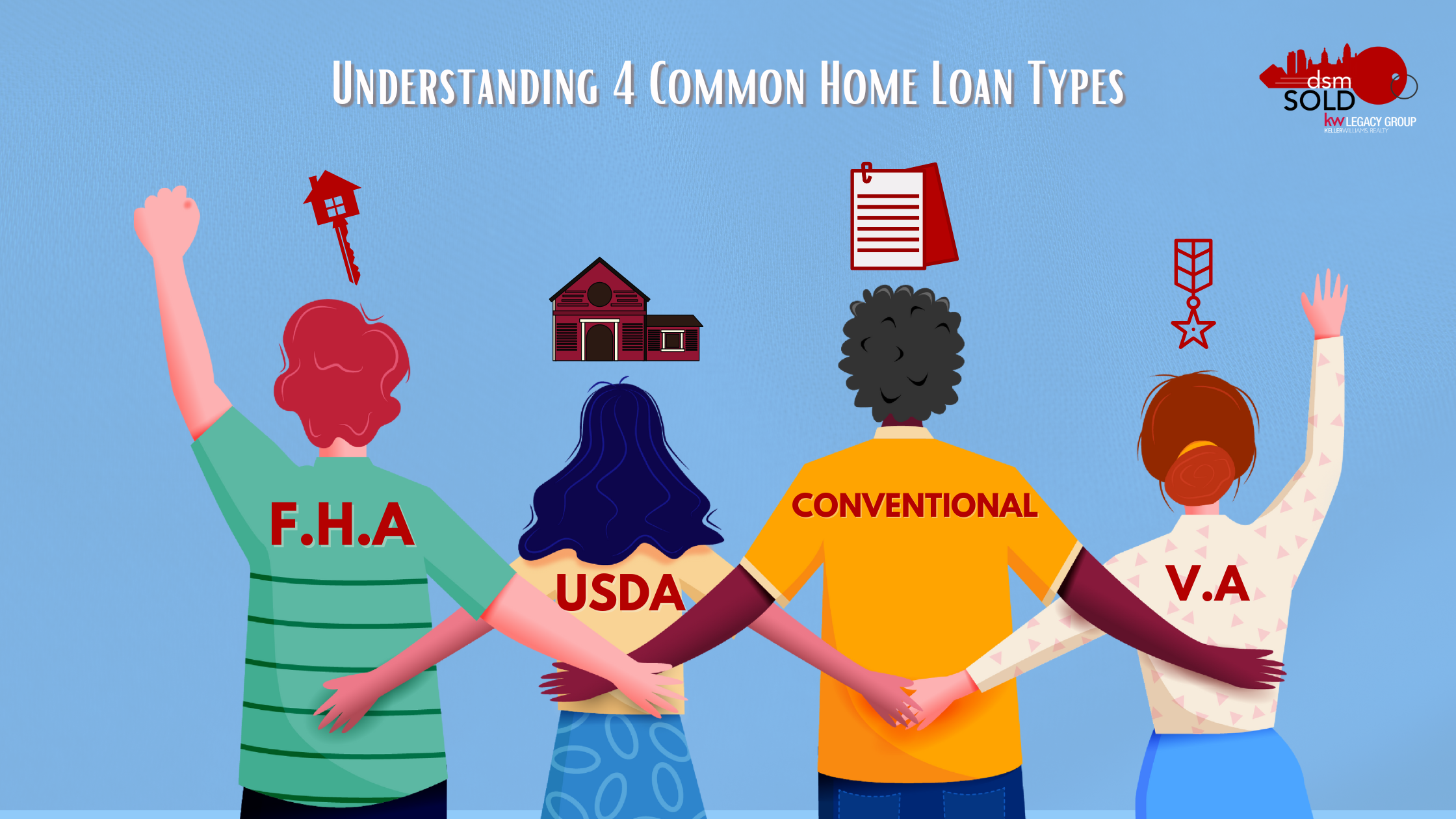
Buying a new home is always exciting no matter what your situation, but it can also be confusing when looking for the right loan type for your home purchase in Des Moines and Central Iowa.
There are a lot of different ways that you can pay for your dream home. While there may be a loan type that is best for you, it's good to know the differences between them before you make the decision.
Finding the right home loan for you can be intimidating. Whether you're going to get a loan from a bank, an online service or work directly with the seller, it's important to know what your options are. Of course, as local agents to Des Moines, the dsmSOLD Team agents are happy to help connect you with amazing local lenders who can share more detailed insights into loan options that may be best for you.
Here are the 4 common home loans that you can get:
Conventional loan
A conventional mortgage loan is a “conforming” loan, which simply means that it meets the requirements for Fannie Mae or Freddie Mac. Fannie Mae and Freddie Mac are government-sponsored enterprises that purchase mortgages from lenders and sell them to investors. This frees up lenders’ funds so they can get more qualified buyers into homes.
Conventional loans are not backed by the government. They are ideal for borrowers who have good or excellent credit and good debt-to-income ratio. Such loans typically require down payments from 3-5% or more, closing costs, mortgage insurance, and points, so buyers have to bring a chunk of cash to closing.
While it is easier to qualify for a conventional loan, buyers need excellent credit to receive the best interest rates.
Conventional loans generally offer lower costs than other loan types, and if you meet credit score requirements and want a down payment of as low as 3%, a conventional mortgage might be the best solution for you.
Conventional Fixed-rate mortgage loan
A "fixed-rate" mortgage comes with an interest rate that won't change for the life of your home loan. A "conventional" (conforming) mortgage is a loan that conforms to established guidelines for the size of the loan and your financial situation. Conventional loans may feature lower interest rates than jumbo loans, FHA loans or VA loans. Terms of these conventional loans typically range from 10 to 30 years. Conventional fixed-rate mortgages are a popular option, but they're not the only ones.
Conventional Adjustable-rate mortgage loan
With adjustable-rate mortgage loans (ARMs), the rate will fluctuate—moving both up and down—based on market interest rates. There is also a hybrid option, where the loan has a fixed rate for a specific amount of time, and then, beyond that, the rate adjusts annually.
ARMs typically start off with a lower rate so they can be appealing, specifically for first-time homebuyers and other buyers on a strict budget. However, because rates rise over time, home owners could find themselves unable to pay later. If this is something that is of interest, especially in a situation where fixed rate options are higher than what you could get for an ARM loan, make sure you understand the adjustment period and all the details. Again, we are here to help you in the Des Moines and Central Iowa area choose the right option for you if you're considering an ARM loan.
Federal Housing Administration (FHA) mortgage program
An FHA loan is a type of government-backed mortgage loan that can allow you to buy a home with looser financial requirements. You may qualify for an FHA loan if you have higher debt or a lower credit score. You might even be able to get an FHA loan with a bankruptcy or other financial issue on your record.
FHA loans are backed by the Federal Housing Administration, an agency under the jurisdiction of the Department of Housing and Urban Development. FHA loans are insured by the FHA, which simply means that this organization protects your lender against loss if you default on your loan.
FHA loans are available with low down payment options and lower minimum credit score limits, but you’ll also have to pay mortgage insurance if you put less than 20% down. And unlike conventional loans, where the mortgage insurance falls off after you reach 20% loan to value, you'll have mortgage insurance for the life of the loan with FHA if you're putting less than 20% down. Often times, you may start with this loan type and refinance into another FHA loan or different loan type when it makes sense.
If you're in the market for a loan with lenient credit, lower down payment and low-to-moderate income requirements, an FHA loan might be right for you.
FHA Fixed-rate mortgage loan
The interest rate on a fixed rate mortgage stays the same throughout the life of the loan, and consequently, so do the minimum monthly payments.
The fixed rate mortgages have either 15 or 30-year terms. While 30-year terms are the most popular, 15-year fixed rate mortgages typically have lower interest rates with higher monthly payments, but more of the money goes toward the principal every month.
FHA Adjustable-rate mortgage loan
With an FHA ARM loan, the mortgage starts with an initial fixed interest rate and monthly payment for a set period of time. When opting for an ARM loan, borrowers may be able to qualify for a more expensive home as a result of the initial low rate and monthly payment. However, because that rate could increase once the initial fixed period is over, continuing to make a higher monthly payment may become more difficult over time.
Veteran Affairs (VA) loan
If you currently serve in the military or are a veteran, you’re potentially eligible for a VA loan.
A VA loan is a low or zero-down payment mortgage option offered to eligible veterans and active duty service members and their families. VA loans are partially backed by the U.S Department of Veterans Affairs (VA) and are issued by private lenders. Should a borrower default, the VA will reimburse the lender for any losses.
So what makes a VA loan so special? VA loans have special benefits only available to eligible veterans, active duty service members, and in some cases, their spouses. VA loans are backed by the government up to 25% of the loan value, making you a less risky borrower to your private lender. This gives you more flexibility in the home buying process if you are eligible.
VA mortgages are considered non-conforming loans because they don’t meet the guidelines of conventional lenders Fannie Mae and Freddie Mac. However, this allows more flexibility for clients to qualify because of their easier credit score requirements. They offer many advantages over conventional loans, including lower interest rates, more lenient borrowing requirements and no down payment due at closing. VA loans also never have monthly mortgage insurance.
U.S. Department of Agriculture (USDA) loan
For rural borrowers who have a steady but low income and are unable to obtain adequate housing through conventional financing, the USDA offers a loan program that is managed by the Rural Housing Service (RHS).
A USDA home loan is a competitively priced mortgage option that helps to make purchasing a home more affordable for low-income individuals living in designated rural areas. The U.S. Department of Agriculture backs USDA loans in the same way the Department of Veterans Affairs backs VA loans for eligible individuals such as veterans and their families.
This government backing means compared to conventional loans, mortgage lenders can offer lower interest rates in many cases. If you qualify, you can buy a home with no down payment, although you’ll still need to pay closing costs.
USDA loans help make purchasing a home more affordable for those living in qualifying rural areas. Though you'll still pay closing costs, if you qualify, you'll likely get a lower interest rate and have no down payment.
CONCLUSION:
When you're trying to decide on a loan type the best thing to do is find someone you trust. This can be a real estate agent, your bank, or even a friend who has recently purchased a home. No matter what loan type you go with you'll want to make sure that it's the best choice for your situation.
In the end there are many different factors to consider when choosing the right loan for you, but there is one thing that all buyers should remember: your home should be a space that you love. Whether it's a simple fixer or something more extravagant, there are plenty of loan types to help you get the space that's right for you, and finding your dream home is what matters most.
We're here for you! We're excited to show you our five star, red carpet experience an get you connected with the right people to make this process a breeze! Give us a call today! We are here to help you understand and uncover the best options for you as you look to purchase a home in the Des Moines, Iowa and surrounding areas.

Ryan Rohlf
Chief Client Advocate | REALTOR® | The dsm SOLD Team at Keller Williams Legacy | Keller Williams Legacy Group Midwest
or another way